Showing posts with label big coversation. Show all posts

Thursday, 4 March 2010

Grass roots CILIP

Bodleian visit


This is the fourth of a series of posts to help me to think about CILIP in the year of the Big Conversation.

This is the one about local involvement. I think my interest in this stems from the commonly held belief about CILIP i.e. that it's all very London-centric. I'd have these conversations with librarians about how CILIP never did anything "local". Before I was qualified I used to accept this argument - if so many people said it then it must be true?

A bit later I got to the stage where I was chartering. At this stage you start to sign up to jiscmail lists and local mailing lists to look for any events that might pad-out erm, I mean "augment" your portfolio. At this stage in your career you're not normally earning too much, so with training and development - the freer, the better... And I was amazed. It turns out our local branch puts on a number of events every year. Including reflective writing for portfolios, a summer outing to visit a unique library and network with others and also more technical events (I attended a Web 2.0 talk from Karen Blakeman which gave me ideas for most of my objectives whilst chartering). This year it's putting on about 10 events - most of which are free to members.

So how could this be when the standard response when talking to anyone about CILIP was:

"Meh. CILIP. Waste of money."

In my experience, when I went looking for local benefits, they were there. So maybe (in our neck of the woods at least) it's not the number of events that's the problem - it's getting the message across? What can we do to engage better with members and change these perceptions? Here's a couple of ideas:

1) Advertise everywhere! It would be just lovely if there was an effective means to advertise events at sub-branch level. Unfortunately, CILIP as an organisation, is not able to provide mailing lists (post or email) of sub-branch members (apparently distribution lists only go down to branch level?). I believe this is something that CILIP needs to sort out. I'm pretty sure we (members) provide details of our sub-branch affiliation and email address when we register - why can this information not be made available to sub-branches to promote local events? Anyhoo, in the absence of mailing lists from central data, sub-branches need to make use of as many other means of communication as possible. Jiscmail lists (yes, do cross-post!), locally maintained email lists (for those who don't jiscmail), cilip website, blogs, twitter and facebook (as well as all those personal networks that we all use) are all important. <rant>I have to say on this point that CILIP are not making things easy for sub-branches (in my experience that is). I have an ongoing saga that is going on far too long to get a sub-branch blog onto CILIP communities. As our strategy is to drive our twitter stream and facebook from the blog this is really holding us up!</rant>

2) Broad representation. I think this is really, really important. Among our sub-branch committee we have experience of public, school, HE, FE, health and commercial libraries. So we're lucky. When we're thinking about events, there's some understanding of what will work or what won't work for different types of librarian. I realise that this is not always the case though. If you're flavour of librarianship is under-represented at sub-branch (or even national) level, why not get involved! Easy for me to say I suppose with a supportive employer and relatively few commitments but you can get involved on any level - without necessarily giving all of your time to CILIP. If your sub-branch make it difficult to get involved (e.g. the meetings are at the wrong time) - ask them to change. They probably just aren't aware that it's a problem.

In summary...

I guess this post reflects what I've been saying in my other posts but on a local rather than national level. Branches and sub-branches need to make an effort to communicate to members from across the sector. It cuts both ways though. The next time you hear someone moan about a lack of events locally, ask them why they've done to make this better!



Thursday, 25 February 2010

Is CILIP Overpriced?

337/365: The Big Money

This is the third of a series of posts to help me to think about CILIP in the year of the Big Conversation.

Yesterday I decided to shun the netbook in favour of some trashy TV (La Femme Nikita on CBS action in case your interested). So I was a bit gutted to check my Google Reader this morning and discover I'd missed a convo on this very topic on Twitter as well as an interesting post from @woodsiegirl which puts the price of CILIP membership in the context of similar organisations and also explores the (very flat in my opinion) pricing structure for CILIP membership - more on that later!. Ah well. You snooze, you loose as they say.

So, my addition to the debate is a quick and dirty survey of other professional bodies. The survey method is poor. Basically I looked on the Directory of UK Professional Bodies for chartered institutes and decided to list the first 5 that made their fees easy to find. The results were:

Chartered Institute of Arbitrators - £280
Chartered Institute of Builders - £228
Chartered Institute of Management Accountants - £216
CIPD - £181 (18 months, have hardship register)
Chartered Institute of Waste Management - £162

Average = £213.40

Where possible I took the price for a chartered member. Not always directly comparable but in this context, the £184 for CILIP membership maybe doesn't look so unreasonable?

Cost is a very basic measure though. Far more important, is value. What value do we get from our CILIP membership? Aside from the Professional development, Support for your career, Staying informed, Networking and community and Special deals listed as member benefits on the CILIP website - just what do we get for our subs? (irony intended! "Just what have the Romans ever done for us!") The majority of votes on @philbradley's twtpoll on member fees think that CILIP membership is worth less than the current rate for the majority of members. Even if CILIP membership is good value, this clearly isn't the perception of alot of members.

I think CILIP should address this. In terms of research, what I've done above is laughable BUT I believe that this issue is so important to CILIP's future that it needs to conduct some proper research. Find out how CILIP compares to other professional bodies in terms of cost and value and be open with the results. If this shows that membership is overpriced (in the context of member wages and the benefits that membership offers) - take it on the chin, work out where the inefficiencies are, and bring the cost down. If it compares well to other professional bodies - then SHOUT about it to members - let them know that, actually, they're not getting such a bad deal!

I think another piece of research that would help is putting a £ value on membership. Find out if members actually earn more than non-members. If not, we have some serious questions to ask about our profession. I'm pretty sure that builders who are chartered members of the Chartered Institute of Builders can use that credential to help their bottom line. Can we as individuals trade on our chartered status in the same way? If not, why not?

The last I'd like to say on this goes back to @woodiesgirl's post. The means adjustment for fees is flat, and getting flatter. In actuality those who most need a professional body to protect their interests (see the last post) can no longer afford to be members. Sorry to get political but this is a political issue. I always thought of librarianship as a pretty right-on profession. The ideal of freely sharing information is one of the last bastions of socialism (imho). Flattening the fees in this way is an easy way to balance the books, but is it consistent with our professional values?

Just a thought. That's all for now.


Tuesday, 23 February 2010

Are we professional?

PROFESSIONAL!!!
This is the second of a series of posts to help me to think about CILIP in the year of the Big Conversation.

Is CILIP is fulfilling its role as a professional body? To answer this I want to find out more about what professional bodies are... what is their purpose and does CILIP fulfil this?

Like the truly lazy librarian I am, I started off by looking at the wikipedia entry for Professional Association . The headline definition is:

"A professional association (also called a professional body, professional organization, or professional society) is a non-profit organization seeking to further a particular profession, the interests of individuals engaged in that profession, and the public interest."

So, very unscientific, but we have 3 roles commonly accepted as being the remit of a professional body. The three elements of CILIP's mission statement are roughly aligned with this (see below) but how well do they do in practice?

1) Further the profession

"set, maintain, monitor and promote standards of excellence in the
creation, management, exploitation and sharing of information and
knowledge resources" (CILIP 2009a)

A few examples have led me to the opinion that CILIP has a way to go in this arena. Firstly, CILIP has been fairly slow to move with the development of social media. It is starting to engage now with CILIP communities and @CILIPInfo (Twitter enquiry service) but remember those frustrated blog posts and comments from last year from members imploring CILIP to get involved in social media? CILIP should be leading the way in this space, not just reacting to protests from forward looking members. In terms of its own information management I have issues as well. Following the recent change of CMS for the CILIP website, I think communication about the changes could have been better. I've also found it frustrating trying to get a sub-branch blog on communities - maybe I'm asking the wrong questions or the wrong people, but I've been frustrated by how difficult it seems to be to create a tool to better share information with our local members. An organisation of information professionals should get this stuff right first time and lead by example.

2) Further the interests of individuals engaged in the profession

"enable its Members to achieve and maintain the highest professional
standards in all aspects of delivering an information service, both for
the professional and the public good" (CILIP 2009a)

I guess this is the one that I hear most about from other librarians. There is a definite perception that CILIP is not active enough in protecting the interests of its members. As I said before I'm not sure how far CILIP should go into arbitration with employers and how much that is the role of unions (although clearly this is an area where the boundary between professional body and trade union is blurred). I see CILIP's role more about setting professional standards (for example in the framework of qualifications) and promoting those professional standards to employers. In an era when we all have to justify ourselves to the bean-counters CILIP does provide support in this area. Quality People Equals Quality Service is one example - a set of resources that outline (for managers who aren't necessarily librarians) why it is important to employ information professionals. CILIP provides this benchmarking and guidance - I think it's up to us as members (or our unions) to take this forwards with employers.

Linked to this (and I'm treading on eggshells here!) I think we, as individuals, have a responsibility develop ourselves professionally. Controversial, but I'm actually in favour of compulsory revalidation. At present, it's quite possible to charter, then engage in zero professional development for the rest of your career and still call yourself a chartered librarian. If CILIP is to promote professionalism to employers it has to be sure that members are maintaining their knowledge and skills (especially in such a fast moving field). For me, revalidation is the only way CILIP has to maintain the value of its qualifications.

What's not so good is the way CILIP is bringing this about. By the time we heard of the recent CPD consultation on revalidation in our sub-branch, the consultation had already closed. If consultation is not communicated effectively people start to feel disenfranchised and negative towards any findings. Maybe I'm being  too harsh. Was it communicated effectively? Try Googling it and make up your own mind :-)

3) Protect the public interest

"support the principle of equality of access to information, ideas and
works of the imagination which it affirms is fundamental to a thriving
economy, democracy, culture and civilisation" (CILIP 2009a)

I think this is pretty much what the ethical principles are all about (CILIP 2009b) but also CILIP is active in promoting these values. The recent open letter to the Prime Minister about the need for school libraries to be a statutory requirement are just one example - they also regularly consult on issues that affect the public interest.

So, in summary, I think CILIP does OK in setting professional values and protecting the public. Where I think it needs to improve is in communicating with members and in setting an example as far as its own information systems and management goes. I'd like it to lead the way with new technology and social media - which is why I believe it is falling down slightly on the first of it's mission statements.

This has turned into a monster post - if anyone's made it this far I'd be very surprised! But if you have, I'd love to hear comments on any of this...

References

CILIP, 2009a. CILIP charter, mission and goals. London: CILIP. Available from: http://www.cilip.org.uk/about-us/mission-goals/pages/default.aspx [Accessed 23 February 2010].

CILIP, 2009b. Ethical principles for library and information professionals. London: CILIP. Available from: http://www.cilip.org.uk/sitecollectiondocuments/PDFs/policyadvocacy/Ethicalprinciplesforlibraryandinformationprofessionals.pdf [Accessed 23 February 2010]

Sunday, 21 February 2010

What is CILIP?

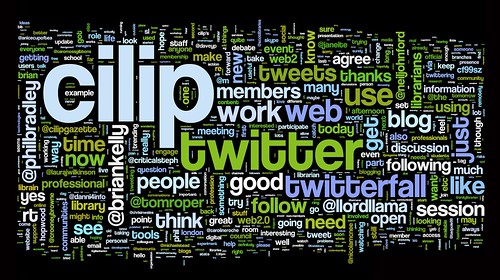
cilip2_full


It's easy to dismiss Twitter as inane but I find it often sparks an idea or gives you insight into other's points of view.

Anyone who follows librarians on Twitter will have seen a fair bit of CILIP-bashing. In fact I've been known to engage in the odd venting of spleen in CILIP's direction myself. Sometimes this has been borne of genuine frustration, sometimes misunderstanding or sometimes (I have to admit) just sheer grumpiness on my part.

My own views on CILIP have changed a bit over the last few years. As I was qualifying (in a public authority that was sacking professional librarians left, right and centre) I thought CILIP should engage more actively with employers to protect jobs and ensure that professional roles were properly rewarded. Looking back, I wonder if I was expecting them to fulfil the role of a trade union?

Later, as I was chartering, I was impressed by the number of (mostly free) events that my local sub-branch put on and my views on CILIP changed a bit. At branch (or SIG) level, the member benefits (like free events) happen because of people who give their time for free to organise these things. Which, I think is why it gets my back up a bit when people complain about there never being any local events. I tend to react to this in an evangelical way, which can come across as patronising - apologies to anyone who's experienced this ;-)

The irony is, I'm still frustrated by CILIP at national level. The cost, the bureaucracy, the length of time it takes to get a response from head office, the resistance to change, ineffective consultation with members (I could go on)... If local benefits are provided by individuals giving their time and there are so many frustrations at national level - just what are our subs paying for?

In the year of the Big Conversation, it seems like CILIP are trying to address the way their members feel about them. It's a good time to answer some of these questions in my own mind so in future posts on this I'll be looking at:

1) What is the role 0f a professional body, and is CILIP a good or bad example?
2) Is CILIP membership too expensive? How does it compare to other professional bodies and what value do we get from it?
3) How can branches engage better with librarians at a local level e.g. what do they need to do to make it easy for people to get involved? How can CILIP at national level facilitate this?
4) What should CILIP expect from it's members? Is paying the subs enough or do we all need to get a bit more, well, involved?

If anyone's made it to the end of this post, well done! ...and feel free to comment.