Showing posts with label cilip. Show all posts

Sunday, 8 April 2012

PTEG Mentor Training

The Karate Kid Trilogy
Easter weekend and the weather scuppered camping plans, so I'm bored! Time to catch up on my much neglected blog.

On 21st March I attended mentor training to register as a mentor for the CILIP Framework of Qualifications. The course I attended was at UWE, Bristol (Frenchay Campus) but you can find local courses on the CILIP training pages.

We didn't get to do any "wax-on, wax-off" but on the whole I found it a really useful day :-) The training included plenty of activities as well as some background information from the facilitators. The morning looked at defining mentoring, considering different learning styles, essential skills for mentoring and mentoring styles... the afternoon session was more about explaining the CILIP mentoring scheme e.g. processes for setting up a mentoring agreement.

I found the morning exercises around core skills like active listening, questioning, and giving feedback really useful - and I think it's also helpful to think in terms of these three skills. I'd certainly like to develop my questioning and feedback skills and I think these are at the core of mentoring. Rather than suggesting solutions it's about asking questions and suggesting points of view that enable the mentee to get to solutions. This is really difficult - if you think you can see the answer to a problem (as a mentor) it's really hard not to just jump in and blurt it out. Getting the mentee to the solution can be time consuming - and doesn't always get you to the answer you expected - but the mentee should be the one coming up with the solutions and learning from whether they worked or not.

In particular, chartership candidates are reaching a level of professionalism where they are moving from roles where you are given tasks to complete (e.g. as a library assistant or in an operational role) to being given more strategic objectives (e.g. in a 1st professional role) where the expectation is that you'll be working in a much more independent way, and may need to influence or motivate others into action. That's really the difference for me. Nobody knows all the answers straight away, but though talking through challenges and barriers (especially with people with a very different perspective) the mentee can come to their own solution.

There was a bit on learning styles and mentoring styles (based on Honey and Mumford and Clutterbuck respectively). I think what's interesting here is that you may go through different learning styles at different times or for different tasks. Also, regarding mentoring styles, it may be necessary to go through a number of different styles in the course of a mentoring relationship but I guess the aim is to move from directive to non-directive styles to get to independent learning.

The stuff in the afternoon on the actual processes was also useful and the handouts were really good and something I'm sure I'll be referring back to often!

I'd recommend this course to anyone considering mentoring for CILIP or also possibly for anyone interested in taking on mentoring roles within their work situation.

Saturday, 9 October 2010

CILIP Training: Timely or Insensitive?

I've been stewing on this ever since I opened a letter from CILIP yesterday advertising a training course called "Recruiting, managing and working with volunteers". I'm not into CILIP bashing for the sake of it - to be honest I sometimes feel that CILIP members have too high expectations of what a professional organisation can do - after all - they are not supposed to be a trade union. However, in a climate where a lot of professionals are now worried about losing their jobs and there is much talk of volunteers replacing paid, professional staff, this letter really got my goat.

Just for the record, I'm not completely against volunteers in libraries, there are certain tasks for which I think they provide really valuable input. There's great work in libraries that would not get done if it weren't for volunteers. My problem though, is with the idea that volunteers can replace paid library workers and I know I'm not the only one who has these concerns. In my opinion, training on the issues surrounding volunteers in libraries - and what professionals can do to ensure that their organisations recognise the value that their professional or paid staff add would be timely. However, looking at the itinerary, this training seems much more geared around recruiting and training volunteers.

I realise I've probably got the wrong end of the stick but with the training costing £220 for members, it just felt to me a bit like CILIP were capitalising on a situation  that a lot of its members are very concerned about (apologies for some slightly "ranty" tweets yesterday!). From the opening sentence of the letter "With the use of volunteers increasing in library and information services it is vital to ensure you are managing and recruiting them correctly." you could argue that this training is timely, but as a librarian, receiving this letter felt a bit like my professional body has given up. I know they're not a trade union, but where there is a conflict of interest between policy/ strategy/ management and professionals, I would expect them to come down on the side of the professional - and for that to be reflected in their training offering.

Am I being too harsh on CILIP? I'd love to hear some discussion on this.


Thursday, 25 March 2010

"Nurture the Belbin plant"

Nerja_321

This is a post on my personal blog about the CILIP in Hants and Wight AGM yesterday. Now that we have our own sub-branch blog I'll post a slightly different version on there also...

...but this one's about what I got out of it personally - so mostly it's about the excellent presentations from Linda Jones and Timothy Collinson.

The theme was the Darkside and the Brightside of the web, with Linda taking the former and Timothy the later. I liked that both presentations allowed audience to participate. Some quite dry topics (like copyright) were dealt with in an interesting and engaging way. As well as demonstrating an understanding of the topic, both presentations showed an understanding of how people learn.

Dark side

The  first of the two presentations was about the dark side. The session kicked-off with newspaper clippings of cautionary tales of the Internet (all from last month) handed out to all . Seeing such a massive folder of clippings about how the internet or public disclosure had somehow gone wrong for folks made quite an impact.
The first topic chosen by the audience was copyright  ("you can tell it's a room full of librarians!"). One example was a 10 minute movie on YouTube called "A Fair(y) Use Tale" - a mashup comprised of Disney clips that explains copyright (irony fans will love this).

Another topic was a Facebook T&C's activity (with sweets) - or perhaps more broadly, getting us to think about what we're signing up to on the web. Sometimes it does pay to read the T&C's! Other examples related to passwords - i.e. lists of commonly used passwords and public disclosure (Tony Blair itinerary being disclosed by his daughter on Facebook for e.g.).

Normally, I switch off to cautionary tales about using the Internet. In my early days as a librarian I heard lots of scaremongering born of fear of the unknown. I think the reason Linda's presentation was so good was she wasn't saying don't use the Internet, just that you should be a bit savvy when you do. One of the key messages was to use the Internet to evaluate the Internet  - if something looks a bit iffey - Google it!

Bright side


Timothy's presentation was about really positive uses of the Internet. About getting user participation - particularly in a HE setting. An interesting concept was his use of Analog -> Digital twitter. This was a fantastic way to get people engaged with Twitter without having to have everybody logged into a computer. At the start of the session the audience were given slips of paper and encouraged to write short messages or thoughts (tweets to the initiated) which were collected and entered to a twitter account through the session. For anyone who's been itching to use Twitter for collaboration in the classroom but has been struggling for a way to do it without everyone: a) having an account and knowing how to use it; and b) having to be logged in to their own computer - here's an answer.

Timothy illustrated a number of positive uses of the internet - especially good examples of web 2.0 usage at UoP.  Their Thing of the Day blog is definitely worth a look as it sneaks IL into posts among more esoteric entries such as Hats of Meat! The key message for me was that librarians need time to play and be creative! "Nurture the Belbin plant in your organisation" was Timothy's parting shot - definitely something to think on.

All in all, top notch. It's a day and several glasses of wine later, for somebody with a goldfish memory like mine to recall this much is testimony to the quality of the presentations.

Thursday, 4 March 2010

Grass roots CILIP

Bodleian visit


This is the fourth of a series of posts to help me to think about CILIP in the year of the Big Conversation.

This is the one about local involvement. I think my interest in this stems from the commonly held belief about CILIP i.e. that it's all very London-centric. I'd have these conversations with librarians about how CILIP never did anything "local". Before I was qualified I used to accept this argument - if so many people said it then it must be true?

A bit later I got to the stage where I was chartering. At this stage you start to sign up to jiscmail lists and local mailing lists to look for any events that might pad-out erm, I mean "augment" your portfolio. At this stage in your career you're not normally earning too much, so with training and development - the freer, the better... And I was amazed. It turns out our local branch puts on a number of events every year. Including reflective writing for portfolios, a summer outing to visit a unique library and network with others and also more technical events (I attended a Web 2.0 talk from Karen Blakeman which gave me ideas for most of my objectives whilst chartering). This year it's putting on about 10 events - most of which are free to members.

So how could this be when the standard response when talking to anyone about CILIP was:

"Meh. CILIP. Waste of money."

In my experience, when I went looking for local benefits, they were there. So maybe (in our neck of the woods at least) it's not the number of events that's the problem - it's getting the message across? What can we do to engage better with members and change these perceptions? Here's a couple of ideas:

1) Advertise everywhere! It would be just lovely if there was an effective means to advertise events at sub-branch level. Unfortunately, CILIP as an organisation, is not able to provide mailing lists (post or email) of sub-branch members (apparently distribution lists only go down to branch level?). I believe this is something that CILIP needs to sort out. I'm pretty sure we (members) provide details of our sub-branch affiliation and email address when we register - why can this information not be made available to sub-branches to promote local events? Anyhoo, in the absence of mailing lists from central data, sub-branches need to make use of as many other means of communication as possible. Jiscmail lists (yes, do cross-post!), locally maintained email lists (for those who don't jiscmail), cilip website, blogs, twitter and facebook (as well as all those personal networks that we all use) are all important. <rant>I have to say on this point that CILIP are not making things easy for sub-branches (in my experience that is). I have an ongoing saga that is going on far too long to get a sub-branch blog onto CILIP communities. As our strategy is to drive our twitter stream and facebook from the blog this is really holding us up!</rant>

2) Broad representation. I think this is really, really important. Among our sub-branch committee we have experience of public, school, HE, FE, health and commercial libraries. So we're lucky. When we're thinking about events, there's some understanding of what will work or what won't work for different types of librarian. I realise that this is not always the case though. If you're flavour of librarianship is under-represented at sub-branch (or even national) level, why not get involved! Easy for me to say I suppose with a supportive employer and relatively few commitments but you can get involved on any level - without necessarily giving all of your time to CILIP. If your sub-branch make it difficult to get involved (e.g. the meetings are at the wrong time) - ask them to change. They probably just aren't aware that it's a problem.

In summary...

I guess this post reflects what I've been saying in my other posts but on a local rather than national level. Branches and sub-branches need to make an effort to communicate to members from across the sector. It cuts both ways though. The next time you hear someone moan about a lack of events locally, ask them why they've done to make this better!


Thursday, 25 February 2010

Is CILIP Overpriced?

337/365: The Big Money

This is the third of a series of posts to help me to think about CILIP in the year of the Big Conversation.

Yesterday I decided to shun the netbook in favour of some trashy TV (La Femme Nikita on CBS action in case your interested). So I was a bit gutted to check my Google Reader this morning and discover I'd missed a convo on this very topic on Twitter as well as an interesting post from @woodsiegirl which puts the price of CILIP membership in the context of similar organisations and also explores the (very flat in my opinion) pricing structure for CILIP membership - more on that later!. Ah well. You snooze, you loose as they say.

So, my addition to the debate is a quick and dirty survey of other professional bodies. The survey method is poor. Basically I looked on the Directory of UK Professional Bodies for chartered institutes and decided to list the first 5 that made their fees easy to find. The results were:

Chartered Institute of Arbitrators - £280
Chartered Institute of Builders - £228
Chartered Institute of Management Accountants - £216
CIPD - £181 (18 months, have hardship register)
Chartered Institute of Waste Management - £162

Average = £213.40

Where possible I took the price for a chartered member. Not always directly comparable but in this context, the £184 for CILIP membership maybe doesn't look so unreasonable?

Cost is a very basic measure though. Far more important, is value. What value do we get from our CILIP membership? Aside from the Professional development, Support for your career, Staying informed, Networking and community and Special deals listed as member benefits on the CILIP website - just what do we get for our subs? (irony intended! "Just what have the Romans ever done for us!") The majority of votes on @philbradley's twtpoll on member fees think that CILIP membership is worth less than the current rate for the majority of members. Even if CILIP membership is good value, this clearly isn't the perception of alot of members.

I think CILIP should address this. In terms of research, what I've done above is laughable BUT I believe that this issue is so important to CILIP's future that it needs to conduct some proper research. Find out how CILIP compares to other professional bodies in terms of cost and value and be open with the results. If this shows that membership is overpriced (in the context of member wages and the benefits that membership offers) - take it on the chin, work out where the inefficiencies are, and bring the cost down. If it compares well to other professional bodies - then SHOUT about it to members - let them know that, actually, they're not getting such a bad deal!

I think another piece of research that would help is putting a £ value on membership. Find out if members actually earn more than non-members. If not, we have some serious questions to ask about our profession. I'm pretty sure that builders who are chartered members of the Chartered Institute of Builders can use that credential to help their bottom line. Can we as individuals trade on our chartered status in the same way? If not, why not?

The last I'd like to say on this goes back to @woodiesgirl's post. The means adjustment for fees is flat, and getting flatter. In actuality those who most need a professional body to protect their interests (see the last post) can no longer afford to be members. Sorry to get political but this is a political issue. I always thought of librarianship as a pretty right-on profession. The ideal of freely sharing information is one of the last bastions of socialism (imho). Flattening the fees in this way is an easy way to balance the books, but is it consistent with our professional values?

Just a thought. That's all for now.


Tuesday, 23 February 2010

Are we professional?

PROFESSIONAL!!!
This is the second of a series of posts to help me to think about CILIP in the year of the Big Conversation.

Is CILIP is fulfilling its role as a professional body? To answer this I want to find out more about what professional bodies are... what is their purpose and does CILIP fulfil this?

Like the truly lazy librarian I am, I started off by looking at the wikipedia entry for Professional Association . The headline definition is:

"A professional association (also called a professional body, professional organization, or professional society) is a non-profit organization seeking to further a particular profession, the interests of individuals engaged in that profession, and the public interest."

So, very unscientific, but we have 3 roles commonly accepted as being the remit of a professional body. The three elements of CILIP's mission statement are roughly aligned with this (see below) but how well do they do in practice?

1) Further the profession

"set, maintain, monitor and promote standards of excellence in the
creation, management, exploitation and sharing of information and
knowledge resources" (CILIP 2009a)

A few examples have led me to the opinion that CILIP has a way to go in this arena. Firstly, CILIP has been fairly slow to move with the development of social media. It is starting to engage now with CILIP communities and @CILIPInfo (Twitter enquiry service) but remember those frustrated blog posts and comments from last year from members imploring CILIP to get involved in social media? CILIP should be leading the way in this space, not just reacting to protests from forward looking members. In terms of its own information management I have issues as well. Following the recent change of CMS for the CILIP website, I think communication about the changes could have been better. I've also found it frustrating trying to get a sub-branch blog on communities - maybe I'm asking the wrong questions or the wrong people, but I've been frustrated by how difficult it seems to be to create a tool to better share information with our local members. An organisation of information professionals should get this stuff right first time and lead by example.

2) Further the interests of individuals engaged in the profession

"enable its Members to achieve and maintain the highest professional
standards in all aspects of delivering an information service, both for
the professional and the public good" (CILIP 2009a)

I guess this is the one that I hear most about from other librarians. There is a definite perception that CILIP is not active enough in protecting the interests of its members. As I said before I'm not sure how far CILIP should go into arbitration with employers and how much that is the role of unions (although clearly this is an area where the boundary between professional body and trade union is blurred). I see CILIP's role more about setting professional standards (for example in the framework of qualifications) and promoting those professional standards to employers. In an era when we all have to justify ourselves to the bean-counters CILIP does provide support in this area. Quality People Equals Quality Service is one example - a set of resources that outline (for managers who aren't necessarily librarians) why it is important to employ information professionals. CILIP provides this benchmarking and guidance - I think it's up to us as members (or our unions) to take this forwards with employers.

Linked to this (and I'm treading on eggshells here!) I think we, as individuals, have a responsibility develop ourselves professionally. Controversial, but I'm actually in favour of compulsory revalidation. At present, it's quite possible to charter, then engage in zero professional development for the rest of your career and still call yourself a chartered librarian. If CILIP is to promote professionalism to employers it has to be sure that members are maintaining their knowledge and skills (especially in such a fast moving field). For me, revalidation is the only way CILIP has to maintain the value of its qualifications.

What's not so good is the way CILIP is bringing this about. By the time we heard of the recent CPD consultation on revalidation in our sub-branch, the consultation had already closed. If consultation is not communicated effectively people start to feel disenfranchised and negative towards any findings. Maybe I'm being  too harsh. Was it communicated effectively? Try Googling it and make up your own mind :-)

3) Protect the public interest

"support the principle of equality of access to information, ideas and
works of the imagination which it affirms is fundamental to a thriving
economy, democracy, culture and civilisation" (CILIP 2009a)

I think this is pretty much what the ethical principles are all about (CILIP 2009b) but also CILIP is active in promoting these values. The recent open letter to the Prime Minister about the need for school libraries to be a statutory requirement are just one example - they also regularly consult on issues that affect the public interest.

So, in summary, I think CILIP does OK in setting professional values and protecting the public. Where I think it needs to improve is in communicating with members and in setting an example as far as its own information systems and management goes. I'd like it to lead the way with new technology and social media - which is why I believe it is falling down slightly on the first of it's mission statements.

This has turned into a monster post - if anyone's made it this far I'd be very surprised! But if you have, I'd love to hear comments on any of this...

References

CILIP, 2009a. CILIP charter, mission and goals. London: CILIP. Available from: http://www.cilip.org.uk/about-us/mission-goals/pages/default.aspx [Accessed 23 February 2010].

CILIP, 2009b. Ethical principles for library and information professionals. London: CILIP. Available from: http://www.cilip.org.uk/sitecollectiondocuments/PDFs/policyadvocacy/Ethicalprinciplesforlibraryandinformationprofessionals.pdf [Accessed 23 February 2010]

Sunday, 21 February 2010

What is CILIP?

cilip2_full


It's easy to dismiss Twitter as inane but I find it often sparks an idea or gives you insight into other's points of view.

Anyone who follows librarians on Twitter will have seen a fair bit of CILIP-bashing. In fact I've been known to engage in the odd venting of spleen in CILIP's direction myself. Sometimes this has been borne of genuine frustration, sometimes misunderstanding or sometimes (I have to admit) just sheer grumpiness on my part.

My own views on CILIP have changed a bit over the last few years. As I was qualifying (in a public authority that was sacking professional librarians left, right and centre) I thought CILIP should engage more actively with employers to protect jobs and ensure that professional roles were properly rewarded. Looking back, I wonder if I was expecting them to fulfil the role of a trade union?

Later, as I was chartering, I was impressed by the number of (mostly free) events that my local sub-branch put on and my views on CILIP changed a bit. At branch (or SIG) level, the member benefits (like free events) happen because of people who give their time for free to organise these things. Which, I think is why it gets my back up a bit when people complain about there never being any local events. I tend to react to this in an evangelical way, which can come across as patronising - apologies to anyone who's experienced this ;-)

The irony is, I'm still frustrated by CILIP at national level. The cost, the bureaucracy, the length of time it takes to get a response from head office, the resistance to change, ineffective consultation with members (I could go on)... If local benefits are provided by individuals giving their time and there are so many frustrations at national level - just what are our subs paying for?

In the year of the Big Conversation, it seems like CILIP are trying to address the way their members feel about them. It's a good time to answer some of these questions in my own mind so in future posts on this I'll be looking at:

1) What is the role 0f a professional body, and is CILIP a good or bad example?
2) Is CILIP membership too expensive? How does it compare to other professional bodies and what value do we get from it?
3) How can branches engage better with librarians at a local level e.g. what do they need to do to make it easy for people to get involved? How can CILIP at national level facilitate this?
4) What should CILIP expect from it's members? Is paying the subs enough or do we all need to get a bit more, well, involved?

If anyone's made it to the end of this post, well done! ...and feel free to comment.

Thursday, 21 January 2010

CILIPHW feeds: To do list

Feed Me
I need to improve the feeds going in to our CILIP sub-branch twitter stream (@ciliphw). At the moment there's a feed from a basic Google News search going in. It's ripped via Dapp Factory then fed in via Twitter feed. Unfortunately the search isn't brilliant and it's picking up a lot of irrelevant stuff. I thought of rss'ing a normal Google search but it's hard to pick up genuine library stories without getting stuff that mentions libraries in other contexts.

Looking at search results, I think the best option is to identify the local newspapers sites then do Google site searches. So the to do list is as follows...

1) Identify all the local papers
2) Search local papers using Google and sort results by dates
3) Get feeds of the search results (either using Google alerts or Dapp Factory)
4) Aggregate the feeds into the twitter stream using the tag #news using twitter feed.

After that I think there are a couple of other sources that might be useful to add to the Twitter stream:
1) CILIPHW news. Hopefully we should have a blog on CILIP communities soon and can take a feed from this for our events etc. #events
2) Local library blogs. #blogs
3) Local library jobs. #jobs (similar to @UKlibraryjobs but for Hants and Wight)

Hopefully, if all goes well, it will also make a good example of a simple mashup for a talk that I'm giving at work in a few weeks.

Wednesday, 29 April 2009

CILIP 2.0 Council Open Session

cilip2_full
cilip2_full by Dave and Bry, on Flickr

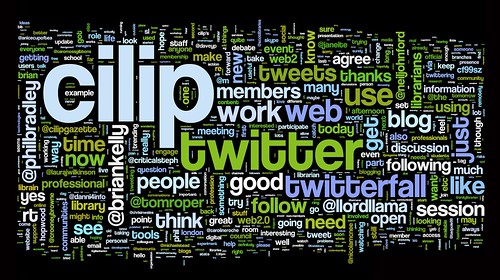
I've been thinking about the CILIP 2.0 Council Open Session yesterday. First off, it was fascinating for me to attend an event like this on Twitter. Although I've followed events from hashtags before, as a relatively new Twitterer, never anything on this scale. The tools that were recommended (Twitterfall and Tweetdeck) worked well for me, although at times there was a bit of lag from Twitterfall so I found myself reverting to Twitter Search occasionally.

I did get some sense of what was happening in the room and a number of Twitterers were very generous in describing what was going on (see @tomroper or @janeite for running commentaries or @daveyp's transcript of the #cilip2 tag for more info).

I've seen some criticism of the Twitter stream as being hard to follow and the thought's or ideas not being coherent, which is interesting in itself. Yes, it's a challenge to put complex ideas into 140 characters but I beleive there are coherent streams (or conversations) within the tag. Perhaps it has as much to do with the number of participants as anything. The more people you have in a group, the looser the conversations tend to get. At least Twitter allowed a large number of people to attend remotely and the stream is there to be analysed/ picked over now. I'm sure some interesting threads will emerge.

What did the day achieve though? Well, I didn't pick up on any hard action or proposals. I can't see that any actual decisions were made by the CILIP top brass. But then I'm not sure that was what the event was about. I get the sense that it was more about CILIP Council *listening* to it's members. This is something I've never heard of before and I really think CILIP Council deserve a big hats-off for hosting the event.

I'd like to see CILIP provide a strong lead in this space. Personally I think they've some catching up to do, but listening and finding out more with events like yesterday's is a very good start.

The event got me wondering: actually, what do I want from CILIP with regards to Web 2.0? Do I want them to leap on the latest hot Web2.0 app? Well, partly. I'd like to see them take more interest in the tools that members are using and, if there is significant demand, engage with their users on those tools. But I think using the latest/ coolest tools in the Web2.0 toybox is a bit misleading. Web2.0, for me, is not about the specific applications it's more a way of being. Being open, encouraging participation, encouraging user generated content, concepts like creative commons etc. The big question for me really is not whether or not CILIP have an "official" Twitter account (although that would be nice!) but whether they are prepared to use Web2.0 to be more open and to provide a place for librarians to openly share their ideas and information.

By extension that means that we - the information profession - have to be more open in sharing our information and content. We have to contribute and get involved. Can we make CILIP2.0 a reality?

Saturday, 31 January 2009

And in the end...

https://blogger.googleusercontent.com/img/b/R29vZ2xl/AVvXsEi3wdfiaBBiFOHhDpmuPHC8B6Ju16DLcnvyE-TIH8LzsQUgJ2J0hHpREiCl1nUOh4tSJdS0F9JjT8M1uH9jZsvS8sAFSu2HWOMwgR9zMM-_DNRhD8tivgm_JiIXE_VysqrV3w2Akknb5ALX/s400/The+Beatles+-+And+In+The+End.jpg ...the love you take is equal to the love you make. Is it? I hope so. The portfolio is printed in triplicate and waiting to get bound and posted next week along with the mentor completion form, so now's a good time to reflect on the process (the blog's kind of fallen by the wayside while I've bene writting the portfolio but, if any future candidates should stumble across this I'd really recommend using a blog to build relective evidence).


So, the theme of this entry, what I'm reflecting on now, is what a GREAT PROFESSION I'm entering (yes you heard me folks - this is about positivity!). I've been very fortunate to have had two amazing mentors. Both have spent time to review documents, have meetings etc. Both have given me great advice (not only about the chartership process but also about the professional issues that I've encountered over the past year) and encouragement. Most importantly, both have pushed me, originally to set meaningful objectives in the PPDP and more recently to see them through.

I guess what I'm really wondering is why? I've been thinking just how lucky I am to be in a profession where (very busy) people are prepared to give a bit of their time and experience to mentor somebody just starting out. I guess this goes beyond the whole chartership thing. While I was taking my MSc. folks always took the time to ask how I was getting on, helped with research and help me getting hold of literature. In the workplace, people have always been ready to share their experience. In my current role for example, the former incumbent happens to work in the same place in a different role. She took time to show me the ropes and still takes time to go for coffee every now and then. Sound things out and generally keep me (as a solo librarian) sane.

I hear a lot of critisism. Both of the profession in general and CILIP in particular. Some of this is starting to grate a bit now. I think my attitude to CILIP has changed over the past year. I felt a bit squeezed out of the public sector having qualified just as a (particularly nasty) restructure hit. At the time I wondered why CILIP didn't do more and weren't more vocal. Now I realise that is probably beyond their remit. They are a professional body not a trade union. What was sad at the time was the tactics that management used to divide professional and para-professional staff. With this division, the effectiveness of collective action was severely hampered and the hatchet fell on the professional side of the workforce. Was that CILIP's fault? On reflection probably not. The failure was primarily with senior management but also (despite my leftist leanings) I have to criticise the union for not protecting it's members against the divisive tactics of senior mangement and unifying the workforce (the are called Unison after all).

The other criticism I hear of CILIP is the cost-benefit thing. How many times have you heard winges about the cost of membership and "what do you get for it?". Well, I'm here to say, there is loads out there if you make the effort to find it. Here in Hampshire there are tons of events and they are often free (or if not they are very cheap). At Ridgemount Street there's stuff going on weekly. If you're prepared to make the effort there are SO MANY ways that CILIP can help you to develop within your profession.

So, is it all sunshine and roses? No, of course not. This is a difficult time but it's important to remember that it's a difficult time for EVERYONE. I honestly feel that in a profession full of people who just LOVE TO HELP others, we are better prepared than many to make it through the hard times.

What's my hope for the future? Well, pass or fail, my hope is that I can give back to the profession (by that I mean library people) as much as it has given me. If we can all Come Together then I've a feeling that the future is very bright. There's a bit from Bob Dylan's autobiography which as always stuck with me. It's about his grandma saying something like.
"Everyone you know is struggling. Try to be nice". Most of the library staff I know live that every day.

Monday, 19 May 2008

Building Your Portfolio : The CILIP Guide by Margaret Watson


This is a cross-posting of my review on librarything...

I thought this was a really well thought out and useful book (for anyone building a CILIP portfolio under the current regulations). One thing that struck me was the range of backgrounds (and career paths) of the contributors. The book's well written and easy to read but I think the best thing about it is the way that it is organised. Each chapter tackles a different aspect of building a portfolio and examples are given for Certification, Chartership and Fellowship. Because the chapters all follow the same format, it's really easy to filter out the bits that aren't relevant to your programme and just focus on the bits you need. I read it in an evening and I'm not a quick reader. Another reason this book is useful is that it outlines the assessment criteria really well and also emphasises the reflective style that the assessors are looking for. From the training I've attended recently I'd say that these are the two key aspects. Demonstrate development in the criteria areas in a reflective way and I'd say you'll be ticking most of the boxes. There's also some useful tools outlined - most importantly, the evidence vs assessment criteria matrix looks like a really good way of ensuring that all of the boxes are ticked. The book is quite pricey (as are all Facet titles) but this one is also good quality. If you can borrow a copy from the library then do so. I made notes and copied a small section (within copyright limits!) and feel I've got most of the info out of the book. On the whole it's really good practical advice and the examples are just there to furnish this. If you read one book on the CILIP chartership process make it this one.

Infinity and Beyond


Ok - so the event was really called Chartership and Beyond but this way it's more fun. This was one of the CILIP run courses that are sort of mandatory if you want to charter. Overall I think it would have been more useful if I'd attended one sooner. There was an exercise on writting objectives and having an overview of the entire process before writting the objectives would have been useful. As it stands though I don't think any of my objectives are too unreasonable and one of the great things that I learnt is they are not set in stone. The course was pretty well organised. The venue is fairly easy to get to (it was interesting to see CILIP headquarters. It's just 5 mins from Goodge Street tube so I certainly won't write it off for other courses). The instructions sent out before the course were good and everything ran to time.

What was useful?

  • Well there was further explanation of the assessment criteria. This has been a really strong theme on both of the courses that I have attended. If I take one thing from them it's that I need to complete "The Matrix" before I do my evaluative statement and write up (guess what the picture's going to be for that post!).
  • Again reflective/ evaluative practice was emphasised. Submitting descriptive portfolios is consistently cited as the number one reason for failure.
  • The event was sort of useful for networking but I felt it could have been better - more on that later...
  • Some good examples of evaluative writting were given in the handout. I need to dig that out before I do my write up.
What was not so useful?

  • The learning style (like the other course that I attended) was again very passive. I would have liked more activities.
  • I think folks would have been more inclined to network if there had been a group activity or icebreaker early on. If this would have happened before the coffee break then I think making conversation in the break would have been easier. As it was the break was fine but I think maybe it was a missed opportunity as far as more lasting/ support type networking went.
  • Timing. As mentioned above I should have attended earlier in the process but that's nobody's fault but my own.
Positives from this were the speakers - who were all very good. One guy (who was sharing his experience of having recently chartered) really exceeded my expectations. I thought that section would be too individual and personal to be of use to anyone else but he actually shared some really pragmatic and useful advice and, perhaps more importantly, helped to put the process in perspective for some of the more intense members of the group. Overall, having attended this one I think the Reflective Writing course was a bit surplus to requirements. It was adequately explained in this course that the statement has to be reflective rather than descriptive and it's also well explained in the book I recently read (stay tuned for a rave review!). If folks don't grasp it after that then is another course going to help them? It's nice that CILIP has identified this common point of failure but this is a professional standard so I'm of the mind that there's perhaps only so much hand-holding that they should do. Maybe these sort of opinions will come back to bite me!

In summary, if I had to attend a course (and I did) it'd be this one.

Wednesday, 6 February 2008

The Angle of Reflection is Equal to the Angle of Incidence

One of those phrases that have stuck with me from physics lessons - I guess some of it must have sunk in. Also, it comes in handy when playing pool. The course on reflective practice last week was not so focused on reflective practice as I thought it would be but it was quite useful in other ways.

Actually the content on reflective practice was very minimal. I need to try and dig out some notes from a course I did years ago that had a brilliant section on keeping reflective journals. What I really liked about it was the learning style - very active. Whilst the content was quite useful last Tuesday it was a very passive way to learn. I think my uni days showed me that I'm not suited to a lecture style of learning. There was one activity, but I personally could have used a bit more explaination (although to be fair I was a bit frazzled - busy week last week). I'll definitely revisit the handout which had some tools on reflective writing that I need to practice. There was also a book which I got for someone at work recently which looks good so I'll have to look that one out.

One of the key messages from the training was that the evaluative statement needs to be written in a positive style - I like the idea of that but I think I'll have to work on that angle of my writing. So, with this in mind, here are the good things that I took from the course...

1) Good to hear from somebody who actually reviews chartership portfolios to get first hand knowledge of what they are looking for.
2) Good to chat to an old acquaintance and meet a new one. Also, it's always good to see that others are in the same boat.
3) It made me reflect on training and learning styles, which is something I haven't done for a while. I think I actually miss delivering training, hmmmm...
4) It has made me think about the way that I write.

Maybe for my next posts I'll work on some of the tools provided.

Monday, 14 January 2008

Web2.0 Backlash?


This was going to be a really positive post about having new books on their way and getting over this New Years malaise that's marked the start of 2008 but I just saw a couple of articles in the Gazette that I find really dissapointing. So I'm going to vent spleen on that instead! The first is on the front page and is titled "Social networking 'not for libraries'" and is about an OCLC report. The report surveyed 6000 members of the public in 6 developed countries and 400 "randomly selected US library directors" (does anyone else think this is a slightly odd sample?). Apparently, 60% did not see a role for libraries in developing social networks.

I've got a few problems with this:

a) The way people are socialising and interacting with each other (and organisations) is changing. Naturally, the public do not see a role for libraries in this trend but how many of the public really understand what libraries do? I don't mean to be patronising but the article cites a 15 year old who thinks that libraries are there to borrow books and occasionally use computers. I see libraries in a slightly different way - basically as places facilitating relationships between people and the information that they need. If libraries don't keep up with the latest ways in which people relate to each other (and information) then they will be dead in the water.

b) How many of the public realise that one of the biggest roles of libraries is in forming and maintaining strong communities. Social networking is all about this. Even if it is not the role of libraries to build social sites (and I would argue strongly that it is!) they should at least be participating in them. Sharing, collaboration and communication are common factors that link social networking and libraries at a fundamental level - common goals if you like.

c) ...and this is my biggest beef. How has this article and the related article on page 3 titled "Are these sites just hype?" (both of which are strongly negative towards the opportunities that social networking sites offer) made their way into the Gazette? Surely it is up to Cilip to provide balanced opinion to it's members. Yes there are negative aspects to social networking and pitfalls that librarians need to be aware of, but to suggest that a) they are a fad and the bubble will burst soon; and b) that libraries have no role in social networking is (IMHO) dangerous (although perhaps indicative of the attitudes that have got libraries and librarianship into the pickle that they are currently in).

I seem to remember these sort of arguments about the Internet in the 90's (ask anyone who works in a public library how busy they are when the Internet goes down).

Cilip Gazette - the next time you print a negative article, how about balancing it with an alternative viewpoint? If I want one sided tabloid journalism I can buy The Sun.

Rant over. Stay tuned for happy, happy, joy, joy.